
Decades of research have made one thing clear: social connection is not optional for healthy aging. Meaningful relationships and socialization benefits rank among the strongest predictors of longevity, on par with physical health factors we’ve long taken seriously. For families navigating care decisions, understanding this changes everything about what “good care” actually looks like.
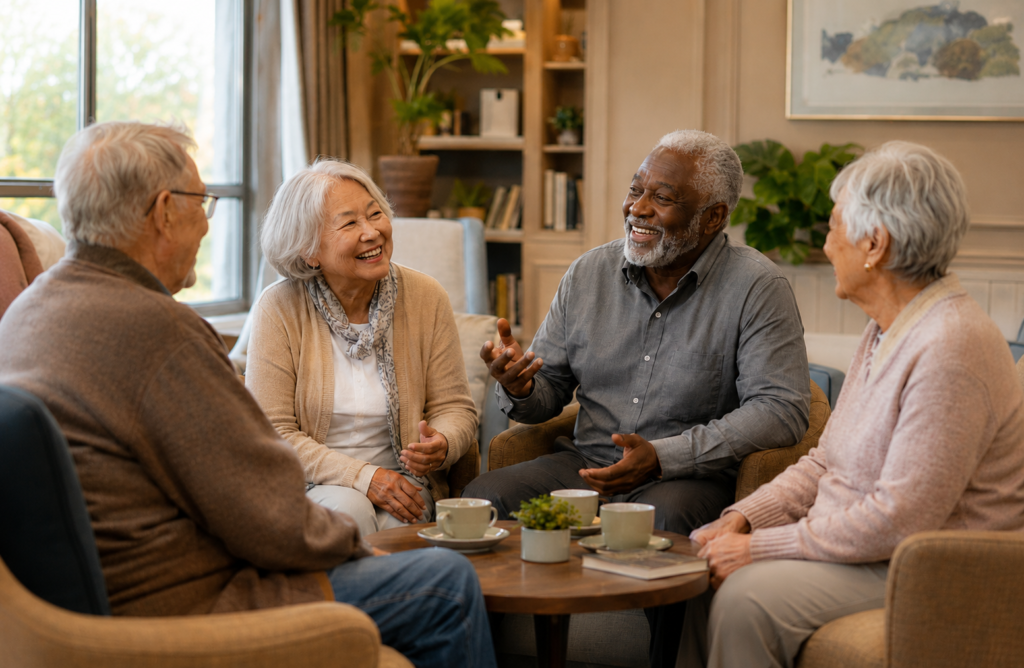
Socialization benefits refer to the documented physical, cognitive, and emotional health outcomes associated with regular, meaningful social engagement in older adults, including reduced risk of dementia, lower rates of depression, decreased mortality risk, and improved cardiovascular health. These are not anecdotal. They are peer-reviewed findings from some of the most respected institutions in medicine and public health.
What Does Research Actually Say About the Health Benefits of Social Connection for Seniors?
The evidence is not subtle, and it does not come from a single study. It comes from decades of longitudinal research across multiple disciplines, and the pattern it reveals is consistent enough to have prompted a formal response from the United States Surgeon General.
In 2023, the Surgeon General’s Advisory on Our Epidemic of Loneliness and Isolation declared social connection a public health priority, citing research linking social isolation to a 26% increased risk of premature death, a 29% increased risk of heart disease, and a 32% increased risk of stroke. These are not quality-of-life statistics. These are survival statistics.
The MacArthur Study of Successful Aging, one of the most rigorous longitudinal studies of older Americans ever conducted, found that social engagement was among the strongest predictors of cognitive vitality and physical health in later life, often outperforming many biomedical factors that families typically focus on.
💡 The pattern across these studies is unmistakable: social connection is not a comfort amenity. It is a clinical intervention with measurable outcomes that rival pharmaceutical and lifestyle interventions in scope.
This is the reframe that matters for families weighing the decision to transition a parent to senior living. You are not choosing between home, which feels familiar and therefore safe, and a facility that provides care. You are choosing between two health environments. And the research is unambiguous about which one tends to produce better outcomes.
What Happens to Older Adults Who Experience Social Isolation?
Understanding the benefits of socialization requires understanding what its absence produces. The research here is, frankly, alarming.
Cognitive decline accelerates. The JAMA Internal Medicine study is one of dozens demonstrating this. Without regular social stimulation, the brain lacks the cognitive demands that appear to maintain neural plasticity. Social isolation is now considered a modifiable risk factor for dementia by the Lancet Commission on Dementia Prevention, Intervention, and Care.
Depression rates climb sharply. The connection between social isolation and depression in older adults is well-documented. According to the CDC, depression rates in this population increase substantially as social contact decreases, with the highest rates found among those who are hospitalized or dependent on home healthcare. The pattern is consistent: the more isolated, the greater the risk.
Physical health deteriorates in measurable ways. Research has documented that social isolation is associated with elevated cortisol levels, disrupted sleep, weakened immune response, and increased inflammatory markers, all of which accelerate the physical decline families fear most.
The will to engage diminishes. This is perhaps the most insidious consequence of social isolation in older adults. When neighbors move away, when driving stops, when a spouse dies, something shifts. Older adults often don’t simply become lonely. They stop initiating. They withdraw from activities they once loved. The social muscle, like any other, atrophies with disuse.
That trajectory is not inevitable. But reversing it requires more than a weekly phone call or a Sunday afternoon visit.
What Types of Social Activities Are Most Beneficial for Elderly Adults?
Not all social contact produces the same outcomes. The research distinguishes meaningfully between types of engagement, and understanding those distinctions helps families evaluate whether a senior living community is providing genuine social programming or simply filling a calendar.
Structured group activities: Fitness classes, book clubs, art programs, and educational lectures produce cognitive benefits beyond simple social contact because they combine social engagement with mental stimulation, physical movement, or creative expression. Studies suggest that participation in structured group activities three or more times per week is associated with significantly higher life satisfaction scores and better cognitive outcomes than unstructured or passive social contact.
Peer-to-peer relationships: Genuine friendships with age peers who share common history, cultural context, and life experience provide emotional validation that younger family members, however loving, cannot fully replicate. There is something irreplaceable about a conversation with someone who remembers the same era, who has faced similar losses, who does not need the context explained.
Intergenerational connection offers a distinct benefit: a sense of continued purpose and relevance. When older adults engage with younger generations, research indicates improvements in self-reported purpose and reductions in depressive symptoms.
Dining as a social ritual deserves its own category. The communal meal is one of the oldest and most powerful human bonding mechanisms, and research consistently identifies shared mealtimes as among the most significant daily social touchpoints for older adults. It is why the Taste Restaurant experience at Avanti Senior Living is designed as a restaurant, not a cafeteria, because the research on social dining and its effects on mood, appetite, and cognitive engagement supports that design decision entirely.
Family engagement remains important but functions differently. Regular family visits reinforce identity, continuity, and emotional security. They do not replace peer socialization, they complement it.
How Does a Senior Living Community Support Meaningful Socialization Every Day?
At Avanti Senior Living, our approach to social programming is grounded in a philosophy we hold without apology: we do not just build communities. We design lives. Every program, every shared space, every daily rhythm is evaluated against a single standard: does this serve the whole person?
- Daily structured programming: Residents have access to fitness classes, creative arts, cultural events, educational sessions, and social gatherings every day. The Avanti lifestyle calendar is built to ensure that meaningful engagement is always within reach, for every interest and every energy level.
- The Taste Restaurant: Shared dining is not an afterthought. It is one of the most research-validated social touchpoints in senior living, and Avanti’s restaurant-style dining experience is designed to make every meal a social occasion, with table conversations, familiar faces, and the dignity of choice.
- Resident-led clubs and interest groups: Autonomy matters. Social engagement that residents themselves initiate and lead produces stronger outcomes than programming imposed from the outside. Avanti communities support resident-driven clubs, hobby groups, and committee participation.
- Salize Memory Care programming: For residents experiencing cognitive decline, the socialization calculus becomes more complex, not less important. Our Salize Memory Care program is specifically designed to provide structured, cognitively appropriate social engagement for residents at every stage of dementia.
When you evaluate a community’s social programming, ask these specific questions:
- What is the daily activity schedule, and who designs it? Look for a dedicated Life Enrichment team, not programming added to a care coordinator’s existing responsibilities.
- How does the community accommodate residents who are introverted, grieving, or in early stages of cognitive decline? Person-centered social programming is not one-size-fits-all.
- What happens on weekends and holidays? The quality of a social program is often most visible in what happens when the formal workday ends.
How Do You Know If a Senior Living Community Takes Socialization Seriously?
Walk the common areas mid-morning. Are residents gathered and talking, or are hallways empty? Listen at mealtimes. Is there laughter? Are staff sitting with residents or standing apart? Ask to see three months of activity calendars. Look for variety, consistency, and evidence of resident participation.
Then ask yourself: does this place feel like home, or does it feel like a waiting room?
That distinction is not decorative. It is clinical. It is the difference between an environment that supports health and one that accelerates decline. Social connection is not the soft part of whole-person care. It is the architecture.
FAQ
Q: Is socialization really as important as physical health for seniors? A: Research from the Surgeon General’s Advisory on Loneliness (2023) indicates that social isolation carries mortality risks comparable to smoking and obesity. Social connection influences cardiovascular health, immune function, sleep, cortisol regulation, and cognitive resilience. It is not separate from physical health, it is a determinant of it.
Q: What are the signs that my parent is experiencing harmful social isolation at home? A: Key indicators include withdrawal from previously enjoyed activities, reduced appetite, increased irritability or sadness, sleeping more than usual, declining hygiene, and significantly reduced verbal engagement.
Q: How do senior living communities provide better socialization than staying at home? A: Senior living communities provide structured daily programming, peer relationships with age-matched individuals, shared mealtimes, and purposeful activity. At home, socialization depends on external logistics that frequently diminish over time. Communities remove those barriers and provide social infrastructure as a constant.
Q: How does Avanti accommodate residents who are introverted or socially anxious? A: Person-centered programming means starting where the resident is. Small-group programming, one-on-one engagement, and low-stimulation options exist alongside larger group activities, because genuine socialization is about meaningful connection calibrated to the individual.
Q: Is it too early to consider senior living if my parent is still relatively independent? A: Research consistently indicates that seniors who transition to communities while they are still active adapt more successfully and build stronger peer relationships than those who transition during a crisis.
Socialization is not a programming feature at Avanti Senior Living. It is a care philosophy, built into the architecture of our communities, embedded in the rhythm of every day, and validated by decades of research we take seriously enough to act on.
If you are evaluating senior living options for a parent, we invite you to see it firsthand. Tour a community or contact Avanti Senior Living to learn more about our programming and what it produces in the lives of our residents.