
Eating alone most nights isn’t a sign of failure; it’s often the natural outcome when cooking for one no longer feels worthwhile. A recipe designed for four gets cut in half, then halved again, until the time spent chopping a single onion outweighs the meal it creates. This isn’t a narrative of decline but rather a matter of simple math, a quiet reality that unfolds nightly in kitchens nationwide.
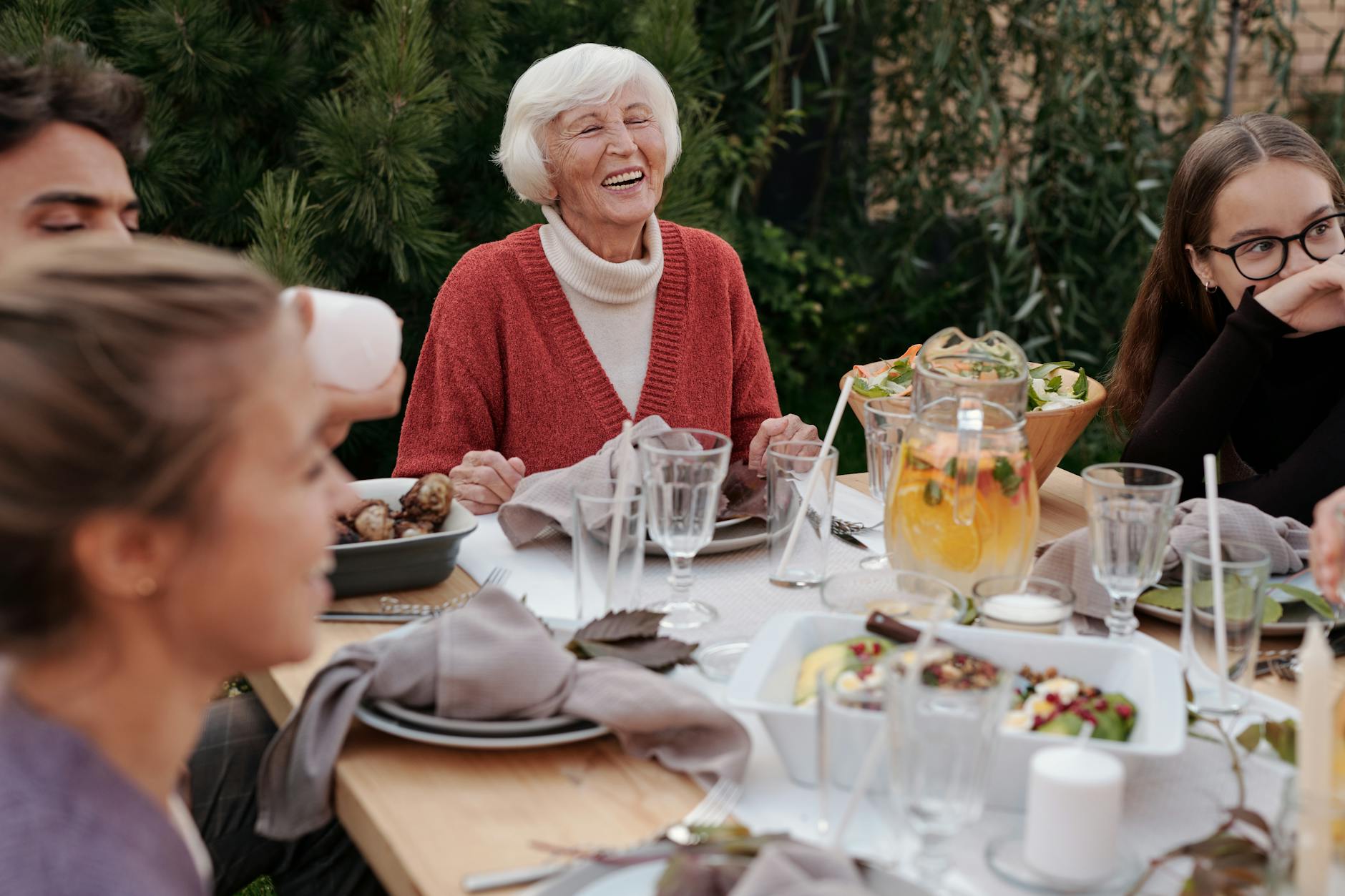
Longevity goes beyond just adding more years to one’s life. It’s about those years being filled with energy, meaningful connections, and a sense of purpose, not merely the absence of disease. Research on aging consistently highlights two key elements influencing how well these years are lived: what we eat and who we share meals with. Chef-prepared, communal dining touches on both, making it an essential part of any meaningful discussion about aging well.
The Quiet Math of Eating Alone
This is a pattern that deserves to be called out explicitly since it’s seldom voiced: eating alone often becomes progressively more straightforward. It’s not that someone chooses to eat poorly, but rather that cooking for one involves an unseen cost absent when cooking for a group. One pork chop on the plate. A canned soup standing in for a proper meal. Forgoing the vegetable because the work required to prepare it doesn’t feel justified by the payoff of eating it quickly at the counter. None of this is a character flaw. It is what happens when the social scaffolding around a meal disappears. Meals were never really about food alone. They were about the people at the table, the conversation that made the food worth preparing in the first place.
Nutrient density suffers first. Protein intake can sometimes drop when someone is cooking only for themselves, and protein is exactly what aging bodies need more of, not less, to maintain muscle mass and strength.
Variety narrows. The same three or four meals get repeated because they’re easy, not because they’re what the body needs.
Motivation erodes. Cooking is not a chore when it’s an act of gathering people. It becomes one quickly when it isn’t.
What Longevity Research Actually Shows
The evidence here is consistent. The MIND diet, developed through research connected to Rush University Medical Center, associates a diet abundant in leafy greens, berries, nuts, and olive oil with a reduced pace of cognitive decline. Additionally, the Academy of Nutrition and Dietetics publishes geriatric nutrition guidance built around a similar principle. Aging bodies need more protein per pound of body weight than younger bodies do, not less, along with adequate hydration and micronutrient density, because appetite naturally declines with age even as nutritional needs stay high or increase.
The social piece is not a footnote to the nutrition science. It is load-bearing. The CDC’s research on social connectedness identifies isolation as a serious risk factor tied to poor health outcomes in older adults, and a shared meal is one of the most natural, low-friction ways that connection happens. Put plainly: what’s on the plate and who’s at the table are not two separate questions. They’re the same question.
The Table as the Real Intervention
This is the point where the two ideas intersect, and it’s important to pause and consider the process rather than gloss over it. When a meal is shared with others, it generally takes longer than when eaten alone. Instead of being hurried, the meal is discussed and savored. People observe what others have on their plates, offer encouragement for seconds, and stay awhile over coffee. These behaviors lead to consuming more food overall, embracing a greater variety, and creating anticipation for the next meal instead of viewing it as a chore to be endured. This is the thinking behind TASTE, the restaurant present in every Avanti community. It is quality service, real plates, and a menu that cuts out deep-fried foods and high-sodium additives like MSG. Residents can eat family-style at shared tables as often as they choose to, and that choice matters as much as the food itself.
Behind TASTE is what Avanti calls the “Green Kitchen,” which is less a place than a way of cooking. Artisanal and small batch rather than large tray. Produce sourced locally and seasonally where it can be. Desserts made on site from scratch rather than delivered in. And menus built around local favorites, red beans and rice, King Casserole, Tex-Mex, so what reaches the table tastes like the place the community is actually in. It is the least visible part of a dining program and the part that quietly decides everything else about it, because a kitchen built to cook in small batches is a kitchen that can cook something to order.
Chef-prepared dining at Avanti starts from a simple observation: a meal is one of the few things that happens every single day, and what it feels like shapes the day around it. Food that looks like it was made for someone, rather than assembled for everyone, invites a person to sit down and stay a while. That matters more than it might sound. Appetite can decrease as we age, so a plate worth looking forward to does real work. It brings people to the table, and the table is where the rest of it happens. The neighbor you did not know last month. The conversation that runs past the end of the meal. The ordinary pleasure of something that tastes the way it should.
Choosing Community Dining Is Not Giving Up Independence. It’s Using It Well.
This decision is often portrayed as a choice between staying home to maintain your independence or relocating and giving it up. That framing does not survive much scrutiny. Preparing every meal solo, running a kitchen, keeping track of groceries, and cooking after a tiring day, none of that is independence. It is labor, work that has to happen whether or not it is still enjoyable. Independence is not measured by who chops the vegetables. It’s measured by whether a person still gets to decide how they spend an evening, who they spend it with, and what they eat when they sit down. Chef-prepared, communal dining removes the labor and hands back the choice. That’s not a smaller version of independence. It’s a more usable one.
Fresh Every Day. Chosen by the Resident
At Avanti, meals are cooked from fresh ingredients each day, and residents choose what they want from a menu rather than receiving whatever the kitchen decided to serve. Dishes are made fresh daily and prepared on request, so a resident who is hungry in the middle of the afternoon is not waiting for the next scheduled meal. Heart-healthy and diabetic-friendly dishes sit on the menu alongside everything else, which means a resident with dietary needs orders the same way everyone else at the table orders.
Choice matters for a different reason. Later life has a way of removing small decisions from a person one at a time, and deciding what you feel like eating tonight is one worth keeping. And when the dish that fits your health needs is simply an option on the menu, eating well stops being a restriction you live under and becomes a preference you exercise. That is the difference between being served a diet and being served dinner.
The dining rooms are designed the way good restaurants are designed. Real table settings, natural light, and a rhythm to the day built around when people actually want to eat.
What it Costs and What it Replaces
Cost is usually the first practical question, and it deserves a straight answer. Senior living pricing is driven by three variables: the level of care a resident needs, the apartment type, and the regional market. Those three move the number more than anything else, which is why a single quoted figure rarely survives contact with a real situation. The useful conversation is the one about your circumstances, and Avanti’s team will have it with you directly.
It also helps to look at what the fee replaces rather than at the fee by itself. At home, eating is a standing cost paid in three currencies. There is money, in groceries, in the items bought and never used, in the meals ordered on the nights cooking does not happen. There is time, in planning and shopping and cooking and the cleaning that follows. And there is energy, which is the one people account for last and feel first. Cooking a full meal for one person takes close to the same effort as cooking for four, and when the effort starts to outweigh the appetite, what ends up on the plate is smaller and simpler than what was intended. Over months, that quietly becomes a nutrition question rather than a convenience one.
At Avanti, that entire chain is handled before the resident sits down. Meals are cooked fresh each day, residents order what they want, and dietary needs are met on the menu rather than as a special request. The value is not only the food. It is the hours and the energy that no longer go into producing it, and the fact that a good meal stops depending on whether anyone felt up to making it that day.
The Table Is Older Than the Diet Plan
Well before nutrition science introduced terms like protein density or micronutrients, people grasped a more basic truth: sharing a meal makes it more meaningful. This intuition remains intact today. It explains why a holiday feast still carries a unique significance compared to a quick Tuesday sandwich eaten standing by the sink. Sharing meals is deeply rooted in a primal survival instinct. Throughout most of human history, eating solo was rare; mealtimes served as natural gathering moments, offering safety and a sense of belonging woven into daily life. This instinct doesn’t weaken over time, in fact, it grows increasingly vital, especially as solitude becomes easier to slip into with age. Having a table surrounded by familiar faces who know your name and hold your spot isn’t a luxury. It stands as one of the oldest and most dependable anchors a person can rely on.
FAQ
Q: Does chef-prepared dining actually make a measurable difference in senior health? A: Consistent, high-quality nutrition plays a crucial role in supporting aging bodies. The Academy of Nutrition and Dietetics emphasizes the importance of protein intake and dietary variety to preserve strength and function. While Avanti doesn’t guarantee specific health results, a thoughtfully designed, appetizing menu forms a key foundation for overall wellness.
Q: How do people afford assisted living and dining programs like this? A: Expenses differ depending on the community, geographical market, and required care level. Many families combine personal savings with long-term care insurance, and sometimes veterans’ benefits. The best approach is to have an open discussion with the community about what’s included in the monthly fee versus additional charges, since factors like dining, care intensity, and apartment choice all influence the total cost.
Q: How can I tell if a senior living community’s dining program is actually good, not just marketed well? A: Request to review a current weekly menu rather than a generic brochure sample, and inquire how dietary needs, such as diabetes, are handled daily. A community that plans menus around residents and offers true table service is telling you that dining matters as much as any other part of daily life.
Q: Is it too soon to consider community dining if I can still cook for myself? A: There’s no single “right” moment. However, many proactive individuals find that transitioning while still energetic and independent allows them to fully enjoy the lifestyle and social benefits, rather than waiting until cooking becomes a challenge. Viewing community dining as an enhancement to your quality of life, not just a solution to a problem, can be a valuable perspective.
If you’re curious about what a shared table could bring to your routine, contact us to explore dining, community life, and a typical day within Avanti’s communities.