
Dental care gets harder with age because of a combination of physical and cognitive changes: reduced saliva production, arthritis that limits fine motor control, medication side effects, and memory changes that disrupt daily routines. None of these reflect a lapse in personal discipline or family oversight. They are physiological shifts that make a lifelong habit, brushing and flossing, noticeably more difficult to perform the same way it was always done.
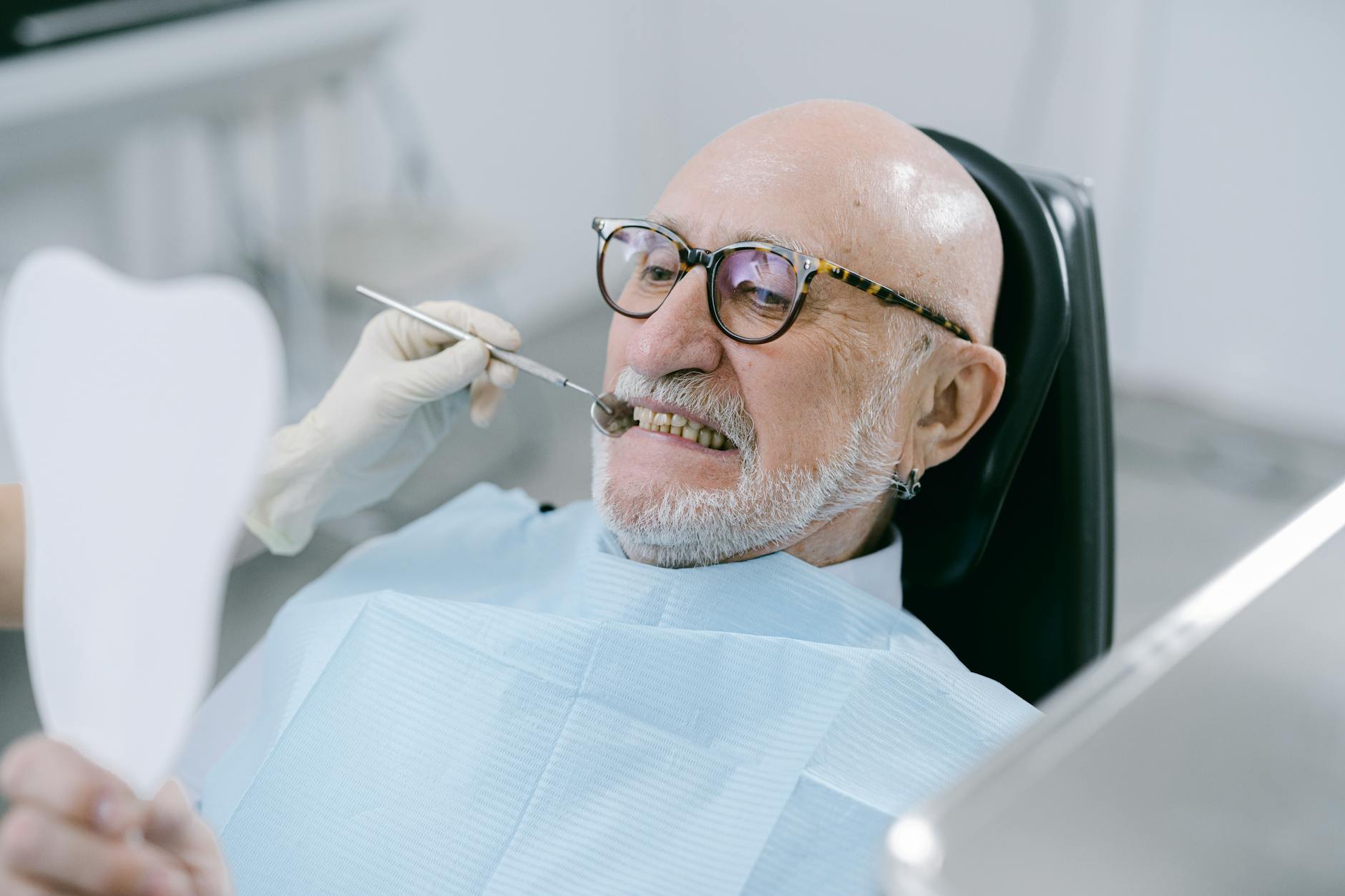
That distinction matters, because the instinct when a parent’s oral hygiene starts slipping is often to wonder how it was missed. The more useful question is not what changed in your attention. It is what changed in your parent’s body and routine, and what can be adjusted in response.
Why Brushing Twice a Day Stops Being Enough
The standard advice, brush twice daily, floss once, see a dentist regularly, assumes a baseline of hand strength, saliva flow, and short-term memory that holds steady over a lifetime. For many older adults, it does not.
Saliva production declines. A condition called xerostomia, or dry mouth, becomes more common with age and is often a side effect of medication rather than aging itself. Saliva does real work: it washes away food particles, neutralizes acids, and helps prevent the bacterial buildup that leads to decay. When saliva volume drops, that protection drops with it, even if brushing habits stay exactly the same.
Gum tissue recedes. Gum recession exposes the root surface of the tooth, which lacks the hard enamel coating and is far more vulnerable to decay and sensitivity. A toothbrush that worked fine on healthy gum tissue for decades can suddenly cause discomfort or bleeding on tissue that has thinned.
Enamel thins. Decades of chewing, acid exposure, and grinding wear enamel down gradually. Thinner enamel means cavities form faster and are harder to catch early, particularly in the small gaps between teeth that are already hard to clean by feel alone.
None of these are failures of effort. They are the reason the same toothbrush and the same routine stop producing the same result.
The Medications in the Cabinet Are Often a Hidden Cause
Many common medications cause dry mouth as a side effect, which is one reason oral health can decline even when brushing habits have not changed. Several of these medication classes list dry mouth among their known effects:
- Antihistamines: Taken for allergies or sleep, these reduce saliva production as a direct pharmacological effect.
- Diuretics: Prescribed for blood pressure or heart conditions, these increase fluid loss throughout the body, saliva included.
- Antidepressants: Many classes, including commonly prescribed SSRIs and tricyclics, carry dry mouth as a documented side effect.
- Blood pressure medications more broadly: Several classes beyond diuretics affect saliva flow as a secondary effect.
A parent taking two or three of these at once can experience dry mouth that raises cavity risk, independent of how well they brush. If you notice a parent’s oral health declining alongside a new prescription or an increased dose, that timing is worth mentioning at their next medical appointment, since a physician may have options to manage the side effect even when the medication itself needs to continue.
When Arthritis Makes the Toothbrush the Problem
Brushing and flossing require sustained fine motor control: gripping a narrow handle, angling the wrist repeatedly, maneuvering floss between tight contacts. Arthritis, particularly in the hands and wrists, can make every part of that sequence painful or physically impossible to complete with the same precision as before.
This is a mechanical problem, and mechanical problems have mechanical solutions. A few adjustments that directly address reduced grip strength and limited wrist mobility:
- Electric toothbrushes with wide, rubberized grips: These require far less wrist rotation and hand pressure than a manual brush, since the brushing motion is generated by the device rather than the hand.
- Floss holders or floss picks: These remove the need to wind floss around fingers and maneuver it with precision, which is often the most painful part of the routine for someone with arthritic joints.
- Water flossers: These clean between teeth using a stream of water rather than a physical string, which can be a meaningful option for someone whose hands can no longer manage traditional floss at all.
If you are helping a parent with limited mobility manage daily brushing directly, positioning and lighting matter more than most families expect. A chair with firm back support, a mirror positioned at the right height, and a bathroom light bright enough to actually see the back teeth can turn a frustrating, rushed routine into one that gets done properly. For a parent who cannot stand for the full routine, brushing seated at a sink or using a handheld mirror while seated elsewhere in the bathroom can make the task manageable without compromising safety.
When Memory Changes Disrupt the Routine Itself
For a parent living with dementia or another cognitive decline, the challenge is not physical capacity. It is that brushing teeth is a multi-step sequence, and multi-step sequences are exactly what cognitive decline disrupts first. A parent may forget they already brushed, resist the task because the sensation feels unfamiliar or intrusive, or simply lose track of the steps partway through.
A few approaches that tend to reduce friction, based on how routines generally work for people with memory changes:
- Keep the timing consistent. Attaching brushing to the same anchor point in the day, right after a specific meal or right before a specific show, gives the brain a cue to follow rather than a decision to make from scratch.
- Simplify the steps. Laying out one toothbrush, pre-loaded with toothpaste, removes decision points that can derail the task before it starts.
- Hand over the toothbrush, don’t just instruct. Physically placing the toothbrush in a parent’s hand and guiding the first motion often succeeds where verbal instruction alone does not, since the physical cue bypasses some of the memory demand.
- Expect resistance sometimes, and adjust the approach rather than the goal. If brushing becomes a point of conflict in the moment, stepping back and trying again later in the day is often more effective than continuing to push.
Denture Care Has Its Own Set of Rules
If your parent wears dentures, the care routine is different from natural teeth. Most dentists recommend taking dentures out overnight to give the gums a rest, then storing them covered in water or a cleaning solution so they hold their shape. Hot water can warp the fit, so it is worth avoiding.
Watch for signs that dentures no longer fit the way they should: sores that don’t resolve, visible slipping while eating or speaking, or a parent avoiding certain foods because chewing has become uncomfortable. Gums and jawbone structure change shape over time, and a denture fitted years ago may no longer match the mouth it was built for. Any of these signs is a reason to schedule a dental visit rather than wait for the problem to resolve on its own.
The Warning Signs That Should Prompt a Dental Visit
A handful of signs are worth treating as a reason to call a dentist, not a reason to wait for the next scheduled checkup:
- Bleeding gums, especially if it happens with normal brushing rather than only with vigorous brushing
- Persistent bad breath that doesn’t resolve with normal hygiene
- Loose teeth, which can signal gum disease or bone loss around the tooth root
- Mouth sores that do not heal on their own, which are worth having a dentist look at
- Difficulty swallowing, or persistent red or white patches in the mouth, which are also worth checking with a dentist
The right interval depends on your parent’s specific health picture, which is a conversation for their own dentist rather than a fixed rule. The ADA’s Find-a-Dentist directory lets you search by location and specialty, which can help if your parent needs a dentist who handles dentures or other specific needs.
What Original Medicare Covers, and What It Doesn’t
Original Medicare does not cover routine dental care, including cleanings, fillings, or dentures, in most circumstances. Some Medicare Advantage plans include dental coverage as a supplemental benefit, but the scope of that coverage varies significantly by plan. If your parent is enrolled in Medicare Advantage, Medicare.gov is the place to confirm exactly what their specific plan covers before scheduling significant dental work.
Supporting Oral Health Without Taking Over
For a parent still living independently, the most useful role a family member can play is often logistical rather than hands-on: noticing the warning signs above, helping schedule and get to appointments, and flagging medication changes that might be affecting saliva production. If your parent is already navigating other daily living challenges, it is worth looking at oral hygiene as one piece of a broader picture of what support actually looks like day to day. Avanti’s post on what to look for in an assisted living facility and the guide to what assisted living assessments actually measure both speak to how daily hygiene tasks, dental care included, factor into a broader understanding of what a parent needs.
If memory changes are part of what’s driving the decline in oral hygiene specifically, it’s worth reading when is it time for memory care, since dental neglect is often one of several small signals that show up alongside bigger ones. And if you are the one managing your own aging parent’s care while also staying ahead of your own health in later life, how to keep your mind sharp and the real benefits of socialization for seniors are both useful companion reads on what sustains wellbeing day to day, not just what prevents decline.
Noticing that a parent’s dental care has slipped and doing something about it is not a sign that something was missed. It is what paying close attention actually looks like.
Contact us to talk through what your parent needs. Avanti offers assisted living and Salize memory care at seven communities in Texas and Louisiana.
FAQ
Q: Can poor dental care actually affect a senior’s overall health, not just their teeth? A: It can affect more than the teeth. The effect families tend to notice first is on eating. Sore gums, loose teeth, or dentures that no longer fit can make chewing uncomfortable enough that a parent quietly avoids certain foods, which over time shapes how well and how happily they eat. Keeping the mouth comfortable is a big part of helping a parent keep enjoying meals.
Q: My parent refuses to let anyone help with brushing their teeth. What should I do? A: Resistance to personal care tasks is common, particularly when cognitive changes are involved, and pushing harder in the moment rarely helps. Try shifting the time of day, simplifying the task to just one step, or asking their physician whether an underlying issue like mouth pain or sensitivity might be driving the refusal.
Q: How do I know if my parent’s dry mouth is from medication or something else? A: Review their current prescriptions with their physician or pharmacist, since several common medication classes list dry mouth as a known side effect. If dry mouth started or worsened around the time a new medication was introduced or a dose changed, that timing is worth raising directly at their next appointment.
Q: Should I be worried if my parent stops wearing their dentures regularly? A: It’s worth finding out why. Dentures that no longer fit well can cause enough discomfort that a parent quietly stops wearing them rather than mentioning the problem, and poorly fitting dentures can affect both nutrition and speech. A dental visit can determine whether the dentures need an adjustment or a replacement.